
|
|
|
 Business News | February 2008 Business News | February 2008 
Migrant Workers Send Billions Home
 Shar Adams - Epoch Times Shar Adams - Epoch Times
go to original
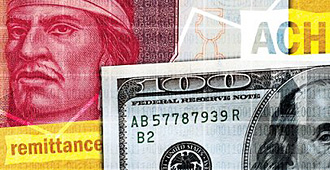
Migrant workers are sending up to $US400 billion ($A440 billion) to their homelands each year – a process that governments are advised to address, says a new report from the Lowy Institute for International Policy in Sydney.
Recorded remittances worldwide were estimated at $US276 billion in 2006, the majority of which were funds sent from workers in developed countries to developing homelands. Add to that informal channels of money, estimated to be roughly half the amount recorded, and the remittance amount far exceeds official aid dollars, the report said.
Author of the report Michael Fullilove says the flow of money is a direct result of diasporas – personal networks of workers overseas who keep strong ties with their native country.
These diasporas, described as the "human face of globalisation", are becoming forces of economic and political power, says Mr Fullilove, and governments ignore them at their peril.
"Diaspora consciousness is on the rise," he said. "Diasporans are becoming more interested in their origins and organising themselves more effectively."
The sudden rise in diasporas is seen as a result of a number of factors eminating from globalisation. The growth in international migration, which to date involves around 200 million migrants globally, has helped fuel the number of foreign nationals working abroad.
While the majority of those are from developed countries, the nature of foreign workers has also broadened.
The report refers to "gold-collar" workers, or those who are not forced to leave their homelands for work, but choose to capitalise on the "war for talent" in the global labour market.
"Indeed, for many gold-collar workers, the idea of a one-off, one-way 'emigration' is redundant; they are highly mobile and are likely to relocate several times over the course of their lives," the report said.
The speed and ease of transport and communication has also enabled workers to maintain close links with their home countries.
Combined with increasing disdain for a global monoculture and changes to national policies to allow transnational features like dual citizenships, the diasporas are getting "larger, thicker and stronger", said the report.
Mr Fullilove is warning governments to treat the issue seriously.
"The triangular relationships between diasporas, homelands and host countries need to be managed adroitly to see they do not become toxic," he said.
High emigration from developing countries, for example, can impose significant economic and social costs for those left behind in homelands.
Diasporic groups are also becoming powerful players in both host countries and home countries. Italy, for example, allows Italians living overseas to vote in national elections, creating issues for those at home.
"It is inherently difficult to design pubic policy in relation to a distant population," he said in the report.
Diasporas can also pose security issues in terms of concealing ethnically-based criminal networks, fostering extremism and supporting insurgencies at home. Equally, they raise concerns about the security of nationals in foreign countries.
"This has implications for power politics because states are likely to bump up against each other as they seek to protect distant citizens," the report said.
While the Australian diaspora is estimated to be around one million people, it is the Irish at around 70 million and the Italian at up to 60 million that top the list in the report.
However, it is the Chinese diaspora (33 million), the Mexican (30 million) and the Indian (25 million) that offer the most interest.
The United States, Saudi Arabia and Switzerland remit the greatest amounts – $A46.5 billion, $A15.5 billion and $A15 billion respectively. But the funds flowing into India, Mexico and China are also worth noting – $A26.7 billion, $A26.6 billion and $A24.5 billion respectively.
These numbers are astronomical and spread across developing countries represent some of the positive results of diasporas.
Developing countries, for example, have been boosted in funding way beyond their aid expectations, while maintaining an outside system of both economic and social support, particularly in times of crisis and hardship.
With this in mind, Mr Fullilove is reportedly to meet with the Australian Government to discuss the economic aspect of diasporas with particular reference to the Pacific region.
"The World Bank is asking us to create a diaspora, partly to create remittances as a form of economic aid," Mr Fullilove told the Australian Financial Review. |
| |
|


 Vallarta Weddings
 Tell a Friend
 Site Map
 Print this Page
 Email Us