
|
|
|
 Business News | February 2008 Business News | February 2008 
Mexican Produce Trucks Flood Nogales Entry
 Gabriela Rico - Arizona Daily Star Gabriela Rico - Arizona Daily Star
go to original
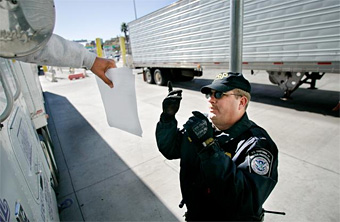
| | Over the noise of idling semis, Sam Shuff, a U.S. Customs and Border Protection officer, lets a Mexican trucker know he's going to check his payload during a pre-inspection in Nogales at the Mariposa Commercial Port of Entry. Now is the agricultural busy season, and more than 1,200 commercial trucks are being processed each day. (Kelly Presnell/Arizona Daily Star) | | |
Nogales, Ariz. — With the busy agriculture season upon them, U.S. Customs and Border Protection officers are hustling at the Mariposa Com-mercial Port of Entry as produce trucks, packed with watermelons, cucumbers and other produce wait for clearance.
More than 1,200 commercial trucks are being processed each day. From January through April, the port is open from 9 a.m. to 3 p.m. on Sundays to help ease congestion.
The $2 billion produce industry in Southern Arizona provides 70 percent of the winter produce coming into the United States from Mexico. Most of it passes through the Mariposa port, in the western outskirts of Nogales.
A new state-of-the-art port of entry is at least five years from being completed, so the U.S. Department of Transportation awarded a $100,000 grant to the University of Arizona to study the bottleneck.
The UA Office of Economic and Policy Analysis and the UA Advanced Traffic and Logistics Algorithms and Systems Research Center will monitor the bottleneck at the commercial port, count vehicles, inspect the Mexican roads leading up to the port and recommend sign upgrades.
The plan is to make recommendations for the port to both countries through the U.S.-Mexico Joint Working Committee in the fall.
Officials from the U.S. Department of Commerce are also trying to put a figure on the hours that trucks spend idling in line.
Contact reporter Gabriela Rico at grico(at)azstarnet.com. |
| |
|


 Vallarta Weddings
 Tell a Friend
 Site Map
 Print this Page
 Email Us