
|
|
|
 Business News | February 2008 Business News | February 2008 
Real, Peso Show U.S. Hegemony Fading in Latin America
 Bloomberg Bloomberg
go to original
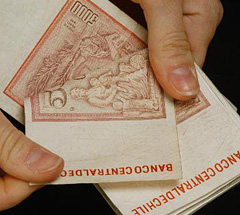
| | Chilean 5000-peso notes are photographed in Buenos Aires. (Diego Guidice/Bloomberg News) | | |
Latin America's history of booms and busts dating back to the days of Spanish explorers Hernan Cortes and Francisco Pizarro may be over, foreign exchange markets show.
Led by Chile's peso, the region has three of the four best-performing currencies against the dollar this year among emerging markets, even as the U.S. economy falters. When the U.S., the biggest buyer of Latin American exports, struggled to pull out of a recession in 2002, six of the region's currencies fell more than 20 percent.
Unlike in past U.S. slowdowns, commodity prices have held near record highs, the result of demand from China and India that has made Latin America less beholden to its northern neighbor. Nations from Brazil to Mexico are taking advantage of record commodity exports to stockpile foreign reserves and pay down international debt. Brazil became a net creditor in January for the first time, its central bank said last week.
"Latin America has far better economic policies and tremendous support coming from high commodity prices," said Jonathan Binder, who oversees $1.7 billion of emerging-market assets at INTL Consilium LLC in Fort Lauderdale, Florida. "The region will be resistant to the kind of risk correlated to the U.S. people previously expected."
Chile's peso has jumped 7 percent, extending its advance to 62 percent over the past five years. Currencies from Brazil, Colombia and Peru are up more than 3 percent this year and are trading near their highest levels in at least seven years. Mexico's peso has appreciated 1.4 percent.
Relative Growth
As record oil, copper and soybean export receipts pour into the region, economists forecast expansions of more than 4 percent this year in Argentina, Brazil, Chile, Colombia, Peru and Venezuela. That's more than double the estimate of 1.8 percent growth in the U.S., according to Bloomberg surveys.
Colombia raised its benchmark interest rate a quarter- percentage point to 9.75 percent on Feb. 22, bolstering the allure of the peso.
Traders are also betting on rate increases in Brazil and Chile. Futures contracts due in January and tied to Brazil's overnight rate trade at 11.73 percent, above the central bank's 11.25 percent target. Chilean central bank 8 percent notes due in July yield 6.45 percent, above the 6.25 percent target rate.
Not everyone's convinced the rally will last. Economists forecast Latin America's currencies will weaken, Bloomberg surveys show.
"In the year-end, I expect to see slower growth throughout Latin America as I think the U.S. recession eventually begins to hit exports both directly and indirectly through a knock-on effect on commodity prices," said Gray Newman, chief Latin America economist at Morgan Stanley in New York.
Aztecs, Incas
"A slowdown in the U.S. will have an effect," said Silvia Marengo, who manages $130 million of bonds at Clariden Bank in London. "What's different now is that these countries find themselves in better financial positions. In the past, we would be talking about which Latin American country would be the next to default."
The boom-and-bust cycle dates back to Cortes's conquest of the Aztec empire and Pizarro's defeat of the Incas in the 16th century, according to Jeffrey Lesser, a Latin American history professor at Emory University in Atlanta. Pizarro bilked some 40,000 pounds of gold and silver out of a captured Incan leader in the 1530s, the beginning of a commodities-driven economic system in South American that lasts today.
`Lost Decade'
By the mid-17th century, Potosi, a silver-mining city in the Andes, had grown into the biggest settlement in the Western Hemisphere. The city then sank into a century-long depression when it exhausted its easily accessible silver deposits.
The Great Depression in the 1930s caused Mexico's economy to shrink 14.8 percent in one year alone.
Former U.S. Federal Reserve Chairman Paul Volcker's move to rein in inflation by driving the central bank's target rate up to 20 percent in 1980 sparked devaluations and defaults in more than 10 Latin American countries. The region plunged into recession, earning the 1980s the moniker the "Lost Decade."
Argentina halted payments on $95 billion of bonds in December 2001, three months after the Sept. 11 terrorist attacks dried up demand for high-risk assets. The next year, currencies in Argentina, Brazil, Mexico and Peru sunk to record lows.
Export Boom
Seeking to break the pattern, countries throughout the region have used the surge in exports to build up reserves and pay down debt.
Brazil's reserves total $188 billion, up six-fold from five years ago. Mexico's have almost doubled to $80 billion, while Argentina's are up more than three-fold to $49 billion. The amount of the region's debt denominated in foreign currencies fell to 24.7 percent of gross domestic product in 2007 from 44.1 percent in 2002, according to the International Monetary Fund.
A growing percentage of Latin American exports are going to Asia, with Brazil sending 6.7 percent of its goods to China last year, double the amount in 2001.
Speaking to bankers in Acapulco last month, Mexican President Felipe Calderon highlighted the increase in the country's exports last year to non-U.S. markets: 48 percent to the Middle East, more than 30 percent to Europe and more than 25 percent to Asia.
Three weeks later, his finance minister, Agustin Carstens, expressed confidence in the economy when he was asked in a television interview what he thought of the decades-old Mexican saying: "When the U.S. gets a cold, Mexico gets pneumonia."
It will be different this year, Carstens said. "I expect we'll only get the sniffles." |
| |
|


 Vallarta Weddings
 Tell a Friend
 Site Map
 Print this Page
 Email Us