 |
|
|
 Editorials | Issues | November 2006 Editorials | Issues | November 2006 
Calderón's First Test: His Inauguration
 S. Lynne Walker - Copley News Service S. Lynne Walker - Copley News Service
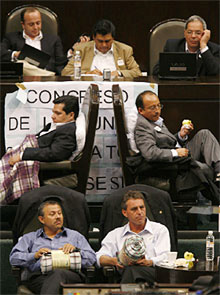
| Congressmen from President-elect Felipe Calderón's National Action Party staged a sit-in yesterday in the congressional chamber where Calderón is scheduled to be inaugurated tomorrow. (Tomas Bravo/Reuters)
Inauguration details
The location: President-elect Felipe Calderón and outgoing President Vicente Fox vow to go ahead with tomorrow's inauguration at the Congress despite plans by some lawmakers to disrupt it. The ceremony may have to be moved.
Scheduled to attend: Former President George H.W. Bush; Gov. Arnold Schwarzenegger.
Demonstration: A major protest is planned in Mexico City's main plaza to coincide with the inauguration. |
With the clock ticking down to Mexico's presidential inauguration tomorrow, the country faces a new political crisis that threatens to undermine Felipe Calderón's administration.
The solemn congressional chamber where Calderón is scheduled to take the oath of office has been a battleground since Tuesday, when members of the president-elect's conservative party exchanged blows with lawmakers from the defeated leftist party who are trying to block the inauguration.
Legislators from the Democratic Revolution Party, or PRD, and Calderón's National Action Party, or PAN, are staging a sit-in that political observers say might not end before scores of visiting dignitaries – including former President George H.W. Bush and Gov. Arnold Schwarzenegger – file into the congressional building known as San Lazaro tomorrow morning.
Jorge Zermeño, a PAN legislator who serves as president of the lower Chamber of Deputies, vowed the melee will not prevent the inauguration from taking place in the Congress as tradition demands, even hinting that he might ask federal police to remove protesting legislators.
Already, more than 3,000 soldiers, federal police and secret service agents are stationed behind steel barricades encircling the Congress to fight off any protesters who might try to storm the building.
Zermeño called on the 77 legislators who spent the night stretched out in sleeping bags on the floor of Congress to “understand that this a place for dialogue and the exchange of ideas. Legislators should not act with their fists, with violence.”
The fight is more than a turf battle over control of the congressional chamber. It has far-reaching implications that must be carefully managed by Calderón to avoid a constitutional crisis, political analysts said.
“This is charged with political significance,” said Soledad Loaeza, a professor of political science at the prestigious Colegio de Mexico.
“The members of the PRD have said they would prevent a constitutional act from taking place,” she said. “Calderón has to be inaugurated in the Congress. If he is not, the message would be that the Mexican state is in shambles. That would create a constitutional crisis.”
The inauguration is the first test of Calderón's strength during what is certain to be a turbulent administration.
Calderón, 44, a Harvard-educated attorney and a career legislator, is described by those who know him as strong-willed, persistent and a fighter. But many Mexicans wonder how Calderón will react to this challenge to his fledgling presidency.
If he chooses to be inaugurated at a more protected location, “it will appear that he is weak from minute one” of his administration, said George Grayson, a Mexico scholar at the College of William & Mary.
“It has to be in San Lazaro because of the symbolic importance,” Grayson said. “If it's done somewhere else, you would have cries that it was illegitimate, that it really didn't comply with the constitution and that he is the illegitimate president.”
For months, Calderón has been dogged by the PRD's taunts that he did not win the July 2 presidential election. The nation's top electoral court ruled that Calderón was the victor, but his margin over defeated PRD candidate Andrés Manuel López Obrador was so small – 0.56 percent – that many Mexicans continue to question the outcome.
López Obrador staged massive protest marches and a monthlong sit-in that choked Mexico City's main thoroughfares. On Nov. 20, he inaugurated himself Mexico's “legitimate president” at an orchestrated event designed to rally support for his plan to disrupt Calderón's government.
“This is not a matter of votes. These are matters of principle. Very serious things have happened in the past few months,” said Congressman Javier González, who heads the PRD delegation.
By blocking Calderón from taking the oath of office in San Lazaro before a quorum of lawmakers, PRD senators and congressman hope to set the stage for a constitutional challenge of his presidency.
The Mexican Constitution does not require that the inauguration take place in the congressional chamber. Two presidents in recent history have taken the oath of office in other Mexico City landmarks, although in both cases it was for logistical rather than political reasons.
However, many experts say the president must be sworn in before a quorum. That legal requirement has prompted political posturing by the Institutional Revolutionary Party, or PRI, whose delegation is large enough to make or break the quorum.
Emilio Gamboa, leader of the PRI's congressional delegation, said after witnessing the melee that his members were “hurt, offended, embarrassed” by the spectacle.
Lawmakers pushed one another down carpeted steps and beat one another with sticks. As television cameras filmed the brawl, one group of lawmakers threatened to attack another group with one of the chamber's elegant, high-backed chairs.
One legislator was whisked out of the chamber in a wheelchair. Another limped away on crutches, his injured foot wrapped in a bandage.
“We are looking for the best way to resolve the conflict,” Gamboa said. “The objective is for President Felipe Calderón to be inaugurated.”
The political trade-off for a peaceful inauguration may be that President Vicente Fox – whom the PRD blames for swaying the election in Calderón's favor – is asked not to attend. Yesterday, PRI legislators joined PRD legislators in approving a resolution demanding that Fox stay away.
In September, Fox was prevented from entering the congressional chamber and delivering his annual state of the nation address.
Mexican tradition dictates that the outgoing president hand over the presidential sash to the new chief executive. Fox's spokesman said the president would participate in that ritual tomorrow.
Even PAN legislators were reviewing the constitution late yesterday to determine whether Fox is legally required to be present, suggesting that they, too, may ask him to forgo the ceremony.
Fox has already moved out of the Mexican White House and into a posh Mexico City hotel. After tomorrow's ceremony, he plans to go home to his ranch in the state of Guanajuato.
S. Lynne Walker: slwalker@prodigy.net.mx
Calderon's Second Test: Oaxaca
Louis E.V. Nevaer - New America Media
Felipe Calderon, Mexico's president-elect, has not taken office yet, but he is already confronting his first crisis: Oaxaca.
When Calderon is sworn in tomorrow as president, his predecessor Vicente Fox will hand him a healthy economy with steady job growth and a favorable investment climate. The strong economy is largely a result of the unforeseen consequences of higher oil prices on world markets and the exceptional remittances from Mexicans working in the United States that now exceed $20 billion a year, and it provides a firm foundation for Calderon's promise to continue Fox's policies to create more jobs.
These promises have made Mexico a darling of foreign investors, hailed by Goldman Sachs "as promising as China or India." But all that could be undermined by the continuing political crisis in Oaxaca.
Last Saturday night, hundreds of demonstrators in downtown Oaxaca City clashed with federal police officers. Demonstrators, many of whom are angry and frustrated university students, defied federal authorities and demanded that the police, who have been occupying Oaxaca City's main square since they moved in to restore order in October, leave at once. Hurling rocks, setting off fireworks and lighting buildings on fire with gasoline bombs, the demonstration spun out of control. Scores of innocent bystanders were hurt and several buildings engulfed in flames. Among those injured were three members of the media: photographer Amaury Guadarrama, from the Cuatroscuro news agency; Virgilio Sánchez, from the "Reforma" newspaper; and Abundio Núñez, from "El Financiero," a financial daily. Federal authorities reported that more than 160 demonstrators were arrested.
This is the latest chapter in a crisis which began in May, when teachers launched a boycott, demanding higher wages and the resignation of Governor Ulises Ruiz, whose election was marred by coercion and fraud. Over the summer, the teachers were joined by other protestors - from bus drivers to farmers, university students to small business organizations.
The protests highlighted the recalcitrant elements in Mexico's south where poverty, privilege and power run along racial lines, with the indigenous peoples - the Zapotec and Mixtec nations - being among the poorest, most disenfranchised and powerless people in Mexico.
That the people of Oaxaca have continued to demonstrate all summer and fall, with the protests escalating into such violence that in late October it required the intervention of federal troops to restore order, shows the paradox of democracy: in an authoritarian regime presidential decrees are carried out no questions asked; in a democracy it's much more difficult to boss people around.
"The president, the Senate, the Chamber of Deputies, newspaper editorials, intellectuals, political scientists - the leaders of his own party - have all demanded that [the governor ] resign," says Raquel Romero, director of Mesoamerica Foundation, an NGO based in Merida.
When the Institutional Revolutionary Party, or PRI, governed uninterrupted for seven decades, such turmoil was unknown: The president, with the PRI leadership as a unified chorus, would demand an offending governor's resignation and an interim governor was appointed to serve at the president's pleasure.
This crisis is as much a test of political wills as it is of democratic institutions. Oaxaca's problematic governor is from the PRI, but Felipe Calderon, like outgoing president Vicente Fox, is from the National Action Party, or PAN.
"Mexican law has no mechanism in place to recall an elected governor," believes Robert Brenner, a European diplomat who has worked with Guatemalan refugees in Chiapas State. "In a democracy, party discipline and a sense of shame count for a lot."
Ulises Ruiz refuses to obey his party leaders, and has vowed to remain in office.
Caleron's transition team fully expected Ruiz to have resigned by now. "There is the hope that Fox will have Ruiz arrested for endangering the public welfare before Friday, one way of handing Calderon an easier time of things," said Raquel Romero earlier this week. "One has to question," she continued "whether Ruiz now poses a national security threat to Mexican civic society."
It's unlikely that the federal authorities will arrest Ruiz. Fox has been reluctant to intervene, as much to "respect" states' rights before federal authority as to avoid a confrontation with a governor from an opposition party. Others point to Fox's lack of political skills for the festering crisis. "The problem with Fox is he didn't know how to govern," said writer and commentator Homero Aridjis. "It's what happens to a lot of revolutionaries and opposition leaders who know how to fight for power but don't know how to rule. For many of us, he left a country in crisis. There has been no government in Mexico since [the presidential elections were held in] July."
The matter was further complicated by the ambivalence Fox has demonstrated for Mexico's southern states, long viewed as "backwards." At a time when the nation's economy has grown - Mexico is one of the top 15 economies in virtually every list compiled by the World Bank - progress is almost impossible to sustain in the southern states. Despite government programs to alleviate poverty, two-thirds of Mexico's poorest citizens are in those states, and the highest levels of illiteracy and malnutrition plague Mexico's indigenous peoples and inner-city dwellers who live there.
More than half of Mexicans who enter the United States illegally seeking work come from the southern states.
Mexican public opinion time and again documents the frustration many feel. The escalation of violence in Oaxaca City this past weekend underscores this sentiment: Although millions of Mexicans want Ruiz to resign, many are angered at the immaturity and provocation of the student demonstrators. Attacking federal troops sent in to restore order does nothing to get Ruiz out of power, but it does erode the moral high ground the protestors have cultivated for months.
Calderon's team is now scrambling, trying for find a solution to this political crisis, one that seems to have no end unless federal authorities seize Oaxaca State offices, a course of action the consequences that would take Mexican democracy in uncharted territories. Mexico - and the world - will have an insight into Calderon's thinking and character as of tomorrow. |
| |
|


 Vallarta Weddings
 Tell a Friend
 Site Map
 Print this Page
 Email Us