 |
|
|
 News from Around the Americas | November 2006 News from Around the Americas | November 2006 
Democrats Score First in Fight for Congress
 John Whitesides - Reuters John Whitesides - Reuters
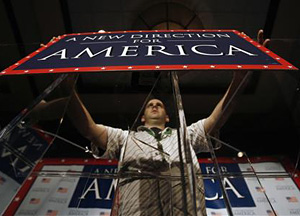
| | Worker David Plevan sets the stage for U.S. House of Representatives Democratic party Minority leader Nancy Pelosi's election night party at a Washington hotel, November 7, 2006. (Reuters/Jason Reed) |
Democrats scored key early victories on Tuesday in a bruising election fight that could sweep President George W. Bush's Republicans out of power in Congress and increase pressure for a new policy in Iraq.
In Pennsylvania, Democrat Bob Casey Jr. defeated Republican Sen. Rick Santorum, the third-ranking Republican in the Senate and one of the Democrats' biggest targets this year.
In a tough House fight in Indiana, Democrat Brad Ellsworth beat Republican Rep. John Hostettler, one of three Republican House incumbents facing tough re-election bids. The other two, Mike Sodrel and Chris Chocola, were in close races in early returns.
Democrats were favored to recapture control of the U.S. House of Representatives from Republicans for the first time since 1994, opinion polls showed, with their chance of taking over the Senate hinging on several key races that were too close to call.
"Certainly the early indications look good but I think we're all prepared to stay up all night and watch to make sure," Democratic Party chief Howard Dean said on CNN.
Republican Rep. Anne Northup of Kentucky, who has survived tough re-election challenges before, narrowly trailed Democratic challenger John Yarmuth with 80 percent of the vote counted.
A Northup loss in a race that had not drawn much national attention could be the first sign of a bad night for Republican members of Congress, who were in tight races in many states.
Republican Sen. Mike DeWine of Ohio trailed in early returns, while Republican Sen. George Allen narrowly led Democrat James Webb with about one-third of votes counted. In New Jersey, Democrat Robert Menendez held on to his Senate seat.
The stakes were high in the fight for Congress, where a Democratic majority in even one chamber could reduce Bush's influence, block his legislative agenda and turn up the pressure on the White House for a shift of direction on Iraq.
It also would give Democrats control of legislative committees that could investigate the Bush administration's most controversial decisions on foreign, military and energy policy.
All 435 House seats, 33 Senate seats and 36 governorships were at stake in the elections and Democrats would have to pick up 15 House seats and six Senate seats to take control of both chambers.
CORRUPTION, ETHICS BIG FOR VOTERS
Early exit polls showed voters disapproved of the war in Iraq by a large margin, but more voters said corruption and ethics were extremely important to their vote than other issues, including the war, CNN said.
In a campaign dominated by Iraq, Bush defended his handling of the war to the end, despite job approval ratings mired in the mid-30s and growing public discontent. He questioned what Democrats would do differently and predicted Republicans would retain control of Congress.
After a five-day swing through 10 states to fire up supporters in Republican strongholds, Bush voted near his ranch in Crawford, Texas, and urged all Americans to vote.
About 50 contested House races and 10 Senate races were the chief battlegrounds. Independent analysts predicted Democrats could gain 20 to 40 House seats, while polls showed races for Republican-held Senate seats in Missouri, Virginia, Tennessee, Montana and Rhode Island were too close to call.
Democrats probably needed to win four of those five Senate races to take control of the chamber.
History was with Democrats - the party holding the White House traditionally loses seats in a president's sixth year.
The battle for the House was fought largely in the East and Midwest, where scores of Republican incumbents were fighting for their political lives amid what polls showed was a strong desire for change.
Election officials and experts reported electronic voting machine glitches in several states, but they said many of the problems were minor and temporary. In Virginia, election officials asked the FBI to look into reports of voter intimidation.
The elections followed a bitter and expensive campaign. Candidates and their political allies were set to spend a record $2.6 billion on campaigns, a watchdog group, the nonpartisan Center for Responsive Politics, said last month.
(Additional reporting by Andrea Hopkins in Ohio, Tom Brown in Florida and Kay Henderson in Iowa) |
| |
|


 Vallarta Weddings
 Tell a Friend
 Site Map
 Print this Page
 Email Us